Enterprise cybersecurity software protects big companies from digital threats. Not like home antivirus. It handles thousands of users. Many locations. Strict rules. It covers endpoints, identity, data, cloud, and threat detection.
The market is crowded. OpenText has a unified cloud platform. MXDR combines tech and people. AI fixes code issues. IBM offers Autonomous Security with AI agents. Armis Centrix watches your whole attack surface. CYE shows risk in money terms.
This article covers what this software does. And how to pick the right one. Start with your risks. Check your rules. Test before you buy.
What Enterprise Cybersecurity Software Does?
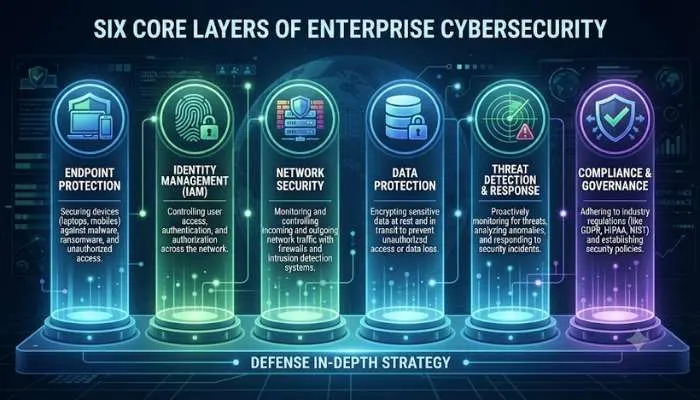
Enterprise security software covers multiple layers of protection:
- Endpoint protection: Secures laptops, desktops, servers, and mobile devices
- Identity and access management: Controls who can access what systems
- Threat detection and response: Monitors for attacks and responds automatically
- Data protection: Encrypts and secures sensitive information
- Compliance management: Helps meet regulatory requirements like GDPR, HIPAA, and PCI-DSS
- Vulnerability management: Finds and fixes security gaps before attackers exploit them
Read More: Cybersecurity Pitch Deck to Investor PPTX: What Investors Expect?
Major Enterprise Cybersecurity Providers
OpenText Cybersecurity
OpenText offers a unified cybersecurity cloud platform that protects data, identities, and applications. The platform includes endpoint security, email protection, data backup, and compliance tools .
Key features:
- MXDR (Managed Extended Detection and Response): Combines technology, people, and process for greater cyber resilience. Built with SentinelOne, the Advanced EDR Agent uses behavioral analytics and real-time threat intelligence .
- PCI-DSS ASV Attestation Services: Powered by SAINT, a trusted Approved Scanning Vendor since 2008. Helps organizations identify vulnerabilities before attackers do .
- Application Security Aviator: AI-powered code fix suggestions that reduce time developers spend remediating security issues .
- Data Discovery & Risk Insights: Discovers and classifies data across repositories to support protection and compliance .
OpenText serves over 150,000 customers and 15,000 partners globally . The platform supports both cloud and on-premises deployments .
IBM Security Services
IBM offers a comprehensive portfolio of security services including advisory, integration, and managed security services. The company positions security as central to business transformation .
Key features:
- IBM Autonomous Security: An AI-native operations model that uses coordinated AI agents to manage risk, strengthen defenses, and respond to threats across the lifecycle .
- IBM Consulting Advantage for Cybersecurity: A unified platform of AI-powered assets that works vendor-agnostically. It simplifies delivery, improves visibility, centralizes automation, and applies agentic AI across all security domains .
- Application Security Service with OpenAI: IBM joined the OpenAI Daybreak Cyber Partner Program to bring frontier AI into security operations. The service goes beyond traditional code scanning to identify and validate vulnerabilities using AI-driven analysis .
- Project Lightwell: A $5 billion initiative combining an enterprise security clearinghouse with a global engineering network to patch, validate, and manage open-source software across the supply chain .
IBM serves clients in more than 175 countries, with a focus on critical infrastructure sectors like financial services, telecommunications, and healthcare .
Other Notable Providers
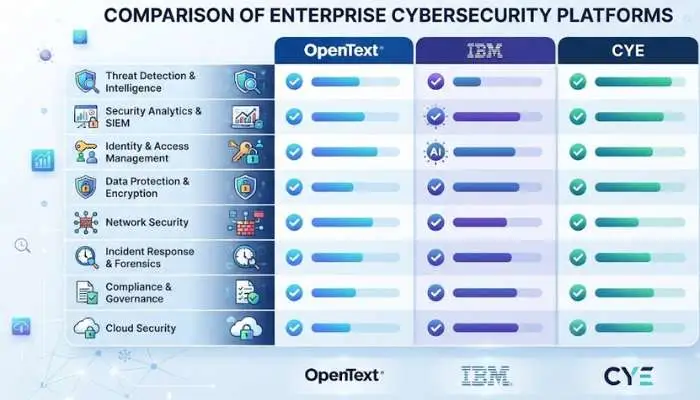
- CYE Platform: Focuses on exposure management with Cyber Risk Quantification (CRQ) at its core. The platform reveals exposure in financial terms, visualizes attack routes, and creates mitigation plans. However, users report challenges with unified reporting across large decentralized organizations .
- Armis Centrix: An asset intelligence platform that protects the entire attack surface. It provides detailed discovery and visibility across IT, OT, and IoT environments. Correlates vulnerabilities, asset criticality, and actual exposure to focus remediation on the highest business risks .
- Sangfor Athena EPP: A centralized endpoint protection platform. Users praise its easy management, reliable threat detection, and lightweight performance. However, some report high false alarm rates and high OS performance consumption .
- N-able: Offers end-to-end cyber resilience with endpoint management, security operations, and data protection. The Adlumin MDR service uses AI to automatically remediate 70% of threats .
- AWS Security Hub Extended: Provides full-stack enterprise security with curated partner solutions. Integrates with 21 partner solutions across 9 security categories including endpoint, identity, email, network, data, browser, cloud, AI, and security operations .
You May Read Also: Cybersecurity Best Practices for Individuals | Stay Safe Online
How to Choose Enterprise Cybersecurity Software?
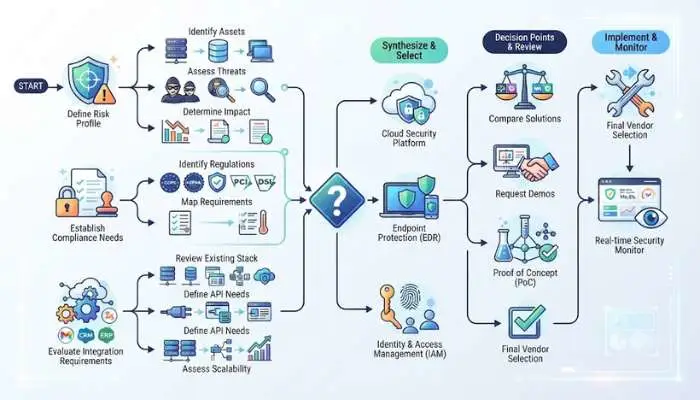
- Start with your risk profile. What are your biggest threats? Phishing? Ransomware? Insider threats? Match the tool to your primary risks.
- Check compliance requirements. Different industries have different rules. PCI-DSS for payments. HIPAA for healthcare. GDPR for EU data. Ensure your chosen platform supports your compliance needs.
- Consider managed services. Many enterprises lack the staff to run security operations 24/7. Managed detection and response (MDR) services provide analysts who monitor and respond on your behalf .
- Evaluate integration capabilities. Your security tools must work together. Look for platforms that integrate with your existing stack and use standard schemas like OCSF .
- Test before you commit. Most vendors offer trials or proof-of-concept engagements. Test with real workloads and real threats.
The Bottom Line
Enterprise cybersecurity software is not optional. It is essential infrastructure. The major providers OpenText, IBM, and others offer comprehensive platforms that cover endpoint, identity, data, and cloud security. The key is matching the tool to your specific risks, compliance requirements, and operational capacity. Start with your biggest gaps. Build from there.
FAQs
1. What is enterprise cybersecurity software?
It protects big companies from digital threats. Not like home antivirus. It handles thousands of users. Many locations. Strict rules. Covers endpoints, identity, data, and cloud.
2. What does OpenText offer?
A unified cloud platform. Endpoint security. Email protection. Data backup. Compliance tools. MXDR combines tech and people for threat response. PCI-DSS scanning finds vulnerabilities. AI fixes code issues.
3. What is IBM Autonomous Security?
AI-native operations. AI agents manage risk and respond to threats. IBM Consulting Advantage works with any vendor. It centralizes automation. Applies AI across security domains.
4. What is Project Lightwell?
A $5 billion IBM plan. Combines a security clearinghouse with a global engineering network. Patches and manages open-source software across the supply chain.
5. How do I pick the right platform?
Start with your risks. What threats worry you most? Check your compliance rules. Consider managed services if you lack 24/7 staff. Check integration with your current tools. Test first.
6. What is MDR?
Managed Detection and Response. Tech plus human analysts. They watch and respond for you. Many companies cannot staff 24/7 security. MDR fills that gap.
7. What is CYE Platform?
Focuses on exposure management. Shows risk in money terms. Maps attack routes. Creates fix plans. Good for understanding risk in business language.
8. What is Armis Centrix?
Asset intelligence platform. Protects your whole attack surface. Finds and watches IT, OT, and IoT. Connects vulnerabilities to business risk. Helps you fix what matters most.