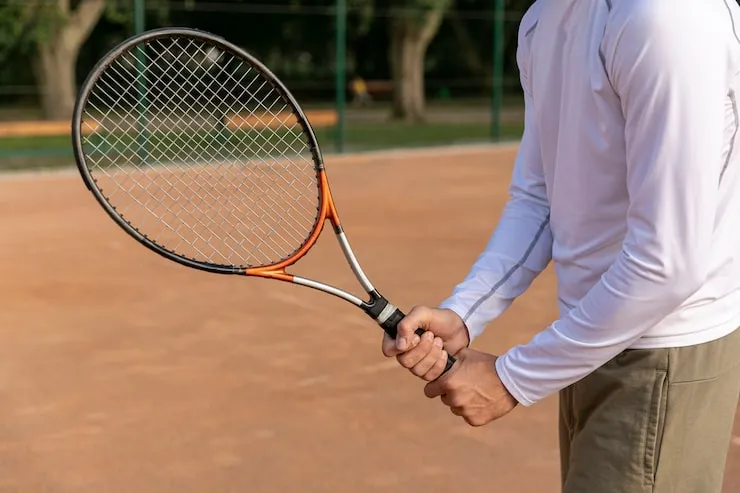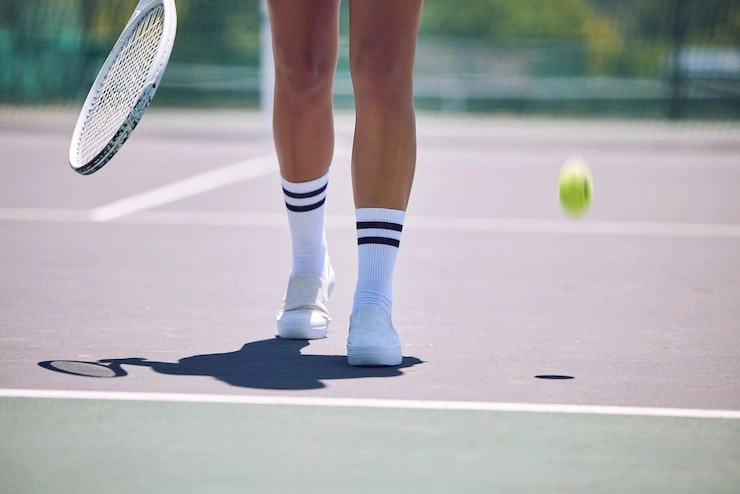
If you are new to tennis, you might think the most important thing is learning how to swing the racket. But here is the truth that many beginners do not realize: your footwork matters just as much as your swing. Maybe even more.
Think about it this way. If your feet do not get you to the right spot, your swing cannot do its job. You will be reaching, leaning, or stretching. The ball will go into the net or fly wide. Your footwork is the foundation for every single shot you hit .
The good news is that footwork is a skill you can learn and improve. It is not about being naturally fast. It is about learning the right movements and practicing them until they become automatic. This guide will show you the best footwork drills for beginners. We will explain why each drill matters and tennis footwork drills for beginners.
Why Footwork Is The Most Important Skill For Beginners?
Many beginners spend all their practice time hitting balls. They try to fix their forehand or backhand. But the real problem is often their feet. A coach at the Mouratoglou Tennis Academy says that the quality of every shot is decided before the swing even starts .
Here is what happens when you have good footwork:
- You get to the ball early
- You have time to prepare your swing
- Your body is balanced and stable
- You can put your weight into the shot
- You hit harder and with more control
Here is what happens when your footwork is poor:
- You arrive late to the ball
- You swing from an off-balance position
- You use your arm to make up for bad foot position
- Your shots go short or into the net
- You make unforced errors that look like bad technique
A study from the British Journal of Sports Medicine found that the average distance players cover per shot is just 3 meters . Tennis is not about running long distances. It is about short, quick bursts of speed in different directions. This is why footwork drills are so helpful.
Key takeaway: Fix your footwork, and many of your swing problems will fix themselves. The two are connected.
Read Also: Tennis Practice Schedule For Beginners
The Most Important Footwork Move: The Split Step
Before we get to the drills, we need to talk about the single most important footwork skill for beginners. It is called the split step.
The split step is a small jump you make just before your opponent hits the ball. You land on the balls of your feet with your feet shoulder-width apart. This position loads your legs like a spring. It helps you push off quickly in any direction.
Research from the Journal of Sports Sciences found that the split step makes players react faster on the court . A study in the European Journal of Sports Science found that players who do the split step well reduce their reaction time by 20% .
Here is how to practice the split step:
- Stand with your feet together
- Jump just a few inches off the ground
- Land with your feet apart and your knees bent
- Your weight should be on the balls of your feet
- Hold this ready position for a moment
- Jump back to the starting position
The split step is like a reset button for your feet. You do it between every shot. It keeps you ready to move.
Off-Court Drills You Can Do At Home
You do not need a tennis court to practice footwork. Many excellent drills can be done in your backyard, driveway, or even inside your house. The United States Tennis Association publishes off-court footwork drills because these exercises produce real results on the court .
Shadow Footwork
Shadow footwork means practicing your movements without a ball. You imagine a ball coming to different spots on the court. Then you move to those spots as if you are going to hit the ball.
Here is how to do shadow footwork:
- Start in the center of your practice area
- Imagine a ball going to your forehand side
- Take your first step toward that side
- Move your feet into position as if you are about to hit
- Hold your finish position for one second
- Push back to the center
- Now imagine a ball going to your backhand side
- Repeat the movement on that side
- Imagine a ball going short or deep
- Practice moving forward and backward
The goal is not speed. The goal is smooth, controlled movement. Watch your feet in a mirror or record yourself on your phone. Make sure your steps are clean and your balance is good.
Players who do shadow footwork at home between lessons often show clear improvement within a few weeks .
Tips for shadow footwork:
- Do this for 15 minutes per session
- Aim for 3 sessions per week
- Practice with and without your racket
- Focus on the split step before every move
Agility Ladder Drills
An agility ladder is a flat ladder you place on the ground. You step in and out of the spaces as fast as you can. This drill develops foot speed and coordination. It trains your nervous system to make your feet move quickly and precisely .
Simple ladder drill for beginners:
- Stand at one end of the ladder
- Step into the first square with your right foot
- Step into the same square with your left foot
- Step into the next square with your right foot
- Step into that square with your left foot
- Continue through the entire ladder
- Turn around and go back the other way
Sideways ladder drill:
- Stand beside the ladder with your feet together
- Step into the first square with your lead foot
- Bring your back foot into the same square
- Step into the next square with your lead foot
- Bring your back foot into that square
- Continue to the end of the ladder
Why this drill works: The ladder forces you to pick your feet up and place them down quickly. This improves your coordination. It trains your brain to control your feet with more precision.
Lateral Cone Slalom
This is another drill that uses cones. It improves your ability to move sideways quickly, which is essential in tennis .
How to set up this drill:
- Place 8 to 10 cones in a straight line
- Space them about one yard apart
- Stand at one end of the line
How to do the drill:
- Start at the first cone
- Face the cones
- Move sideways around the first cone
- Move sideways around the second cone
- Continue weaving through the cones
- Go all the way to the end
- Turn around and weave back
This drill is harder than it looks. Your feet need to be quick and light. You should not drag your feet on the ground.
Backward variation: Once this becomes easy, try doing the same drill going backward . This is more challenging for your balance and coordination. But it is great practice for the movements you need in a real match.
Hexagon Test
This drill measures how quickly you can move in different directions. It also helps you develop better balance .
How to set it up:
- Use tape to make a hexagon on the floor
- Each side should be about 24 inches long
- Stand in the center of the hexagon
How to do it:
- Jump forward over one side of the hexagon
- Immediately jump back into the center
- Jump over the next side of the hexagon
- Jump back into the center
- Continue jumping over all six sides
- Complete three full circuits
Keep your feet together when you land in the center. Your goal is to complete the three circuits as fast as you can. An excellent time is under 12 or 13 seconds .
When you first try this drill, you might lose your balance. That is normal. Make sure your feet are stable before you jump again. Rushing will make you slow down.
Stair Drill
Stairs are a great tool for footwork practice. Going up and down stairs develops leg strength and coordination.
How to do it:
- Find a set of stairs with at least 10 steps
- Go up the stairs stepping on every step
- Go down the stairs stepping on every step
- Try going up by stepping sideways
- Try going down sideways
More advanced: For a greater challenge, try skipping a step as you go up. This develops explosive leg power..
You May Also Like: How To Practice Tennis Without A Court
On-Court Drills For Tennis Practice
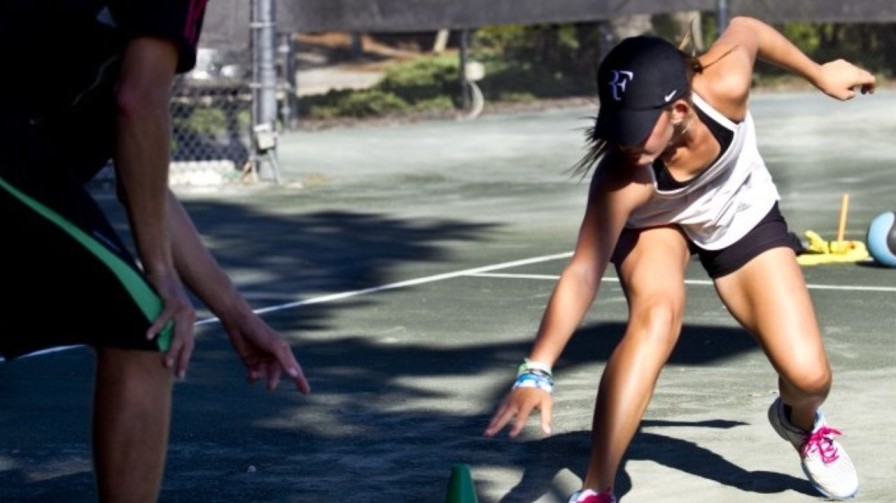
When you are on the court, you can practice drills that are more specific to tennis. These drills help you connect your footwork to real shot situations.
The Fan Drill
The fan drill is one of the best drills for developing quick first steps . It teaches you how to move from the center of the court to different spots.
How to set it up:
- Stand at the center of the baseline (the back line of the court)
- Place cones or markers at different spots in front of you
- The markers should form a fan shape
- Some markers should be to your forehand side
- Some markers should be to your backhand side
- Some markers should be short and some deep
How to do it:
- Start in the center with your knees bent
- A coach or partner calls out a direction (forehand, backhand, short, deep)
- Sprint to that marker as fast as you can
- Touch the marker
- Sprint back to the center
- Get ready for the next direction
Make sure you do the split step before every move. This makes the drill more realistic.
Shadow Swing Drill
This is the on-court version of shadow footwork. It adds the swing to the movement.
How to do it:
- Stand in the center of the court with your racket
- Imagine a ball is coming to your forehand side
- Do a split step
- Take your first step toward the ball
- Move into position
- Make your forehand swing without a ball
- Hold your finish position
- Recover back to the center
- Imagine a ball coming to your backhand
- Do a split step
- Move to the ball and swing your backhand
- Recover to the center
The speed of the drill matters less than the quality. Take your time in the beginning. Make sure each step is correct. Speed will come with practice.
Research from Tennis Fitness shows that brief sessions where you work at maximum speed and intensity cause the fastest neurological adaptation . This means short, focused drills are better than long, tennis footwork drills for beginners.
Split Step Jump Practice
The split step is so important that it deserves its own drill.
How to do it:
- Stand on the baseline facing the net
- Have a partner stand on the other side of the net
- Your partner holds a ball and pretends to serve
- When your partner starts their motion, do your split step
- Land on the balls of your feet
- Be ready to move in any direction
- Your partner says which direction you should go
- Move in that direction for 2 steps
- Return to the center
- Repeat 20 times
This drill trains your body to do the split step automatically. It becomes a habit. Once it is a habit, it will happen without you thinking about it.
Spider Run Test
The spider run is a speed and agility drill that uses tennis balls . It helps you develop quick changes of direction.
How to set it up:
- Place a tennis ball at each corner of the singles court
- Place one ball on the center service line (the T in the middle)
- Place a box behind the center of the baseline using tape
How to do it:
- Start at the baseline in the center
- Sprint to one corner ball
- Pick it up and bring it back to the box
- Sprint to the next corner
- Bring that ball back to the box
- Continue until all balls are in the box
Your goal is to finish as fast as possible. Near or below 15 seconds is a good target .
This drill is very tiring. Do not do too many repetitions. Two or three attempts with rest in between is plenty.
Horizontal Repeater
This is a challenging drill that develops speed, agility, and conditioning . Do not try to go too fast when you start.
How to set it up:
- Stand at the doubles sideline (the outside line)
- Face the net
How to do it:
- Shuffle sideways to the center service line
- Sprint back to the doubles sideline
- Sprint toward the opposite doubles sideline
- Shuffle sideways to the center service line
- Sprint back to the doubles sideline
- Sprint back to your starting position
Important: You should complete 2 or 3 repetitions of this pattern. Rest for 30 seconds between repetitions.
This drill might be too hard at first. You can make it easier by reducing the distance or going slower. It is better to do the drill correctly at a slower speed than to do it fast with poor form.
How Often To Practice
Consistency is more important than the length of your practice sessions. The tennis fitness research shows that brief sessions where you work at maximum speed and intensity cause the fastest improvement .
Recommended schedule:
- Practice footwork drills 3 times per week
- Each session should be 15 to 20 minutes
- Do 2 off-court sessions per week
- Do 1 on-court session per week
When you will see improvement: Most beginners notice meaningful footwork improvement within four to six weeks of consistent practice . The first two weeks are the hardest. The movements feel unnatural. You have to think about them. By weeks three and four, the split step and first step begin to feel automatic. By weeks five and six, moving around the court starts to feel smoother and less tiring.
The Connection Between Footwork And Shot Quality
Many beginners make a mistake. They try to fix their shots by changing their swing. But the real problem is footwork. When you are in the right position, you hit better shots with the same swing.
Think about what happens when you arrive at the ball correctly:
- Your feet are set
- Your body weight moves forward
- Your swing path stays level
- You hit the ball at the right distance from your body
Every one of these factors makes your shot cleaner and more powerful .
Now think about what happens when you are late:
- Your body is reaching
- Your weight is leaning backward
- Your racket path goes off course
- You make contact too close or too far from your body
The result is a weak shot or an error. Coaching experts say poor footwork is the cause of most unforced errors at the recreational level . It is not a swing problem. It is a movement problem disguised as a swing problem.
The lesson: When your shots are not working, check your feet first.
Common Mistakes To Avoid
Mistake 1: Skipping the split step
Some beginners forget to do the split step. They stand flat-footed and wait for the ball. When the ball comes, they are slow to react. The split step is not optional. It is essential.
Mistake 2: Taking big steps instead of small steps
When you approach the ball, you should take big steps at first and then smaller steps to adjust. Some beginners take all big steps. They arrive at the ball off-balance. Practice taking your last few steps before contact smaller and more controlled.
Mistake 3: Standing up straight
Tennis requires an athletic stance. Your knees need to be bent. Your weight needs to be on the balls of your feet. Beginners often stand too straight. This makes them slow to move.
Mistake 4: Running through the shot
Some beginners do not stop before hitting. They are still moving when they swing. You need to be set and balanced before you make contact. Practice stopping your movement for a moment as you swing.
Mistake 5: Not recovering after the shot
After you hit, you need to move back to the center of the court. Beginners often watch their shot and forget to move back. This leaves them out of position for the next shot.
Tips For Faster Improvement
Use a mirror or record yourself
Watching your feet helps you see your mistakes. You might think you are taking small adjustment steps. But when you look at the video, you see your steps are actually big and clumsy. Video gives you the truth.
Practice without a ball first
Removing the ball from your practice forces your full attention onto movement quality . When you add a ball, your brain focuses on the ball. You stop paying attention to your feet. Practice your footwork without a ball. Then add the ball once your feet are moving correctly.
Warm up before drills
Do not start footwork drills cold. Do some light jogging or jumping jacks first. This prevents injury and helps you move better.
Rest between sets
Footwork drills require maximum effort. You need rest to recover. Resting helps you maintain good form on each repetition.
Focus on quality over speed
In the beginning, speed does not matter. Correct movement matters. Go slow. Make sure every step is right. Speed will come naturally as your body learns the patterns .
Connect footwork with your stroke
When you practice your strokes, practice the footwork that goes with them. The forehand is not just an arm swing. It is a footwork pattern followed by a swing. Learn them together .
Frequently Asked Questions
How long does it take to improve tennis footwork?
Most beginners see real improvement within four to six weeks of practicing two to three times per week . Full mastery of footwork at a recreational club level takes six months to two years. But the early improvements are noticeable and satisfying.
Can I improve my footwork at home without a court?
Yes. You can do shadow drills, agility ladder exercises, and cone shuffles at home . These are just as effective as on-court drills for developing coordination and quickness. You do not need a court, a ball, or a partner.
What is the one footwork skill every beginner must learn?
The split step . It is the foundation of all tennis movement. Without it, you will always be reacting late. With it, you will be ready to move in any direction at any time.
Why do my shots go into the net even when my swing feels good?
Poor footwork often causes the ball to go into the net . If you arrive too close to the ball or off-balance, the racket face angles down. The shot goes down. Check your feet before you change your swing.
How much should I practice footwork drills?
Aim for 15 to 20 minutes of footwork practice, three times per week . Short focused sessions are more effective than long unfocused sessions.
Conclusion
Tennis footwork is a skill you can learn. You do not need to be a natural athlete. You do not need to be fast. You just need to practice the right movements consistently.
The drills in this guide will help you develop:
- Quick first steps
- Good balance and posture
- Quick changes of direction
- Automatic split step
- Faster reaction times
Commit to practicing these drills for six weeks. Practice three times per week. You will notice a real difference. You will get to the ball earlier. Your shots will be more consistent. You will feel more in control.