Knowing how to improve car fuel efficiency tips can save you hundreds of dollars every year without buying a new car. The biggest gains come from four things: your driving habits, tyre pressure, speed on the highway, and how well you maintain the engine. Smooth acceleration, keeping tyres inflated to the right pressure, cruising at 80–90 km/h on the highway, and replacing dirty air filters all make a measurable difference. Small changes stack up fast. This guide covers every practical method backed by real numbers so you can start saving fuel today.
How to Improve Car Fuel Efficiency: Why Most Drivers Waste More Than They Realise?
Most drivers think fuel economy is mostly about the car. It’s not. The way you drive matters far more than the car you’re driving. A skilled driver in a standard sedan can outperform a careless driver in a hybrid. That’s not an opinion fuel economy testing labs have demonstrated it repeatedly.
Here’s a number worth sitting with: aggressive driving hard acceleration, late braking, speeding lowers fuel economy by 15 to 30% on highways and up to 40% in city traffic. That’s not a small margin. For someone spending $150 a month on petrol, that’s potentially $45 to $60 in avoidable waste every single month. The good news? Every habit on this list costs nothing to change. No mechanic, no new parts, no expense.
Improve Car Fuel Efficiency: Tips Through Smarter Driving Habits
The single most impactful category in any list of improve car fuel efficiency is driving behaviour. Everything else tyres, maintenance, fuel type gives you marginal gains. Driving habits give you the biggest chunk. Think about how most people drive on a commute. They accelerate hard to keep up with traffic, brake late at lights, and sit in the wrong lane doing 20 km/h over the limit. Every one of those moments is burning extra fuel for zero benefit.
The shift is simple to describe, harder to stick to: anticipate traffic, accelerate gently, and let the car coast to slow down rather than braking at the last second. It feels slower. Your actual journey time barely changes. But the fuel savings are real.
- Gentle acceleration: Take 5–8 seconds to reach your cruising speed instead of flooring it
- Early braking: Lift off the accelerator early and let the car roll to a stop rather than pressing the brake hard at the last moment
- Anticipate traffic lights: Watch the lights ahead if they’re red, stop accelerating and coast
- Avoid unnecessary idling: If you’re stopped for more than 60 seconds, switching off the engine saves fuel most modern cars do this automatically
- Reduce short trips: Cold engines burn significantly more fuel in the first few kilometres. Combining errands into one trip helps
The data is unambiguous. Smooth driving is the number one lever for fuel economy. More than tyre pressure, more than maintenance intervals. A driver who coasts and anticipates saves more fuel than a driver who over-inflates tyres and keeps a perfect service record but drives aggressively." David Park, Senior Engineer, Vehicle Fuel Systems Testing, Seoul
You may also read :- Top 10 Safety Features in Cars You Should Know Before Buying
Ways to Increase Fuel Efficiency: The Maintenance Side People Keep Ignoring
Driving habits get all the attention. But there’s a parallel category of ways to increase fuel efficiency that sits entirely in the maintenance column and a surprising number of drivers let these things slide for years without realising what it costs them.
A clogged air filter, for example. Studies by the US Department of Energy found that a dirty air filter can reduce fuel economy by up to 10% on older carburettor-style engines. On modern fuel-injected engines the effect is smaller but still measurable the engine management system compensates, but it does so by burning more fuel.
Spark plugs are another one. Worn spark plugs misfire. When a spark plug misfires, fuel passes through the cylinder unburned. That’s fuel you paid for, doing nothing. Replacing spark plugs at the manufacturer’s recommended interval usually every 30,000 to 100,000 km depending on type keeps combustion clean and efficient.
Increase Fuel Efficiency: Maintenance Checklist With Real Savings Estimates
|
Maintenance Item |
Estimated Fuel Saving |
|
Clean / replace air filter |
Up to 10% on older engines, 1–3% on modern |
|
Replace worn spark plugs |
Up to 4% |
|
Use correct engine oil grade |
1–2% |
|
Fix a faulty oxygen sensor |
Up to 40% (a broken sensor causes major over-fuelling) |
|
Replace clogged fuel injectors |
3–5% |
|
Keep cooling system in good condition |
1–2% (engine warms up faster, less cold-start waste) |
That oxygen sensor figure deserves special attention. A faulty O2 sensor tells the engine computer the wrong air/fuel ratio. The ECU overcompensates by dumping in excess fuel. Fuel economy can drop by 40%. It’s one of the most common reasons a car suddenly starts burning noticeably more petrol for no obvious reason.
The Effect of Tire Pressure on Car Fuel Economy
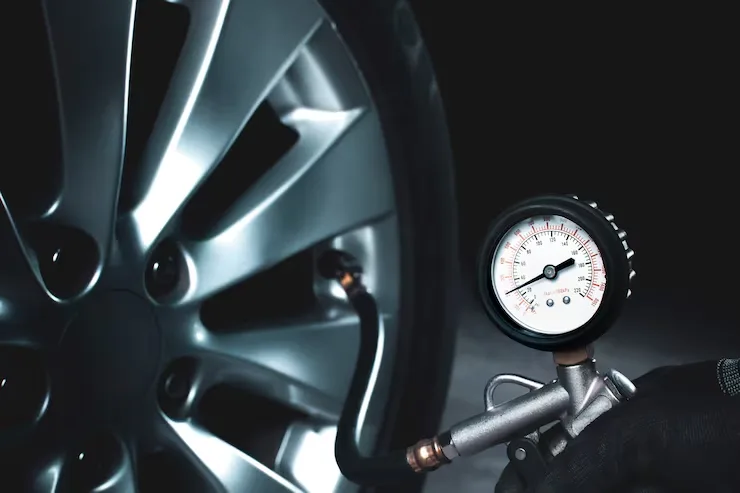
The tire pressure effect on fuel economy is probably the most talked-about and most frequently ignored tip in fuel efficiency guides. People know about it. They just don’t check their tyre pressure.
Under-inflated tyres create more rolling resistance. More rolling resistance means the engine works harder to push the car forward. That means more fuel. The numbers aren’t enormous roughly 0.2% fuel economy loss for every 1 PSI under the recommended pressure but most drivers run 5 to 8 PSI under without realising it. That adds up to around 1–2% fuel waste that could be fixed with a two-minute stop at a petrol station air pump.
Find the correct tyre pressure number on a sticker inside the driver’s door jamb. Not on the tyre sidewall that’s the maximum tyre pressure, which is different. Check when tyres are cold, ideally in the morning before driving.
Tire Pressure and Fuel Economy How Often to Check and What Numbers to Use
Once a month is the general recommendation from tyre manufacturers. More often if temperatures swing significantly tyres lose about 1 PSI for every 5-degree Celsius drop in temperature. So a car that was perfectly inflated in summer could be 4 or 5 PSI under by winter.
- Check monthly: Cold morning, before driving, petrol station air pump or home gauge
- Target pressure: Find the sticker inside the driver’s door jamb usually 32–35 PSI for most passenger cars
- Don’t over-inflate: Running tyres above recommended pressure reduces grip and wears the centre tread faster the fuel saving is marginal at best
- TPMS warning light: If your car has a tyre pressure monitoring system, the light typically only triggers when a tyre is 25% below recommended that’s already significant under-inflation
Best Speed for Fuel Efficiency Highway The Number That Surprises Most Drivers
Most drivers guess that the best speed for fuel efficiency highway is somewhere around 100–110 km/h. The actual answer is lower than that, and by a meaningful margin. Aerodynamic drag increases with the square of speed. That means going from 80 km/h to 120 km/h doesn’t just increase drag a little it increases it by a factor of 2.25. The engine is doing significantly more work at highway speeds than most people appreciate.
The sweet spot for most petrol and diesel cars is 80–90 km/h. At this speed, the engine sits in its most efficient RPM range for most vehicles, aerodynamic drag is manageable, and fuel consumption is genuinely minimised. Pushing to 110 km/h typically increases fuel consumption by 15–20%. At 130 km/h, it’s more like 30–40% more fuel versus 90 km/h.
Best Speed for Fuel Efficiency on Highway Speed vs Fuel Use Data
|
Highway Speed |
Approx. Fuel Use vs 90 km/h Baseline |
|
70 km/h |
Similar to 80 km/h minimal gain, time cost not worth it |
|
80 km/h |
Best fuel efficiency for most cars |
|
90 km/h |
Near optimal reasonable balance of speed and economy |
|
100 km/h |
~7–12% more fuel than 90 km/h |
|
110 km/h |
~15–20% more fuel |
|
120 km/h |
~25–30% more fuel |
|
130 km/h |
~35–45% more fuel |
Where legal limits allow, sitting at 90 km/h in the slow lane on a long highway trip genuinely produces noticeable fuel savings. A four-hour highway drive at 90 km/h instead of 120 km/h can save a quarter to a third of a tank. For anyone doing regular long-distance driving, that’s a meaningful annual amount.
Eighty to ninety km/h is the fuel efficiency sweet spot for the vast majority of modern cars. The engine is in its most efficient operating range, drag is manageable, and gear selection is optimal. Going faster feels productive but it’s costing you more than people realise. Maria Santos, Automotive Fuel Economy Researcher, University of Porto
Improve Gas Mileage in Car Quick: Wins You Can Do This Weekend
Some of the best tips to improve gas mileage in car don’t require booking a service appointment or waiting for anything. Here are things you can sort out in an afternoon.
Improve Gas Mileage in Car Weekend Checklist for Immediate Results
- Remove the roof rack: An empty roof rack increases aerodynamic drag by 2–8%. Take it off when you’re not using it
- Clear the boot: Every extra 45 kg of weight reduces fuel efficiency by roughly 1–2%. Most cars carry unnecessary weight constantly
- Check and inflate tyres: Takes two minutes at any petrol station. Worth doing right now
- Park in shade: A hot cabin means running air conditioning harder immediately on startup. Small but real
- Fill up in the morning: Fuel is denser when cold, so you get marginally more energy per litre. Minor gain, but costs nothing
- Use engine braking on descents: Keep the car in gear going downhill modern fuel injection systems cut fuel delivery completely when you lift off in gear
- Air conditioning vs windows: Below 80 km/h, open windows beat A/C. Above 80 km/h, the aerodynamic drag from open windows costs more than the A/C draws
Reduce Fuel Consumption Driving Habits The Highway vs City Breakdown
The strategies for reduce fuel consumption driving habits differ depending on where most of your driving happens. City and highway driving waste fuel in completely different ways.
City Driving Where Your Fuel Goes
In city traffic, most fuel waste comes from acceleration and idling. The car stops and starts constantly. Every time you accelerate from zero, you’re burning fuel to overcome inertia. Every time you brake hard after accelerating, that kinetic energy converts to heat and is lost.
The city driver’s best weapons: gentle acceleration, reading traffic well ahead, and minimising stops. Using cruise control isn’t practical in city traffic, but consciously keeping a bigger following distance gives you more time to coast rather than brake.
Highway Driving Where Your Fuel Goes
On the highway, speed and aerodynamics dominate the equation. Air conditioning load matters more at sustained speeds. Driving into a headwind can increase fuel consumption by 5–10% compared to calm conditions not something you can control, but worth knowing when filling up more than usual on a windy day.
Cruise control on the highway is worth using. Even small speed variations speeding up and slowing down by 5–10 km/h repeatedly add up to measurable fuel waste over a long drive. Cruise control eliminates this.
Fuel Efficiency Tips That Actually Add Up Realistic Annual Savings
Putting numbers on this makes the advice more useful. For a driver covering 15,000 km per year in an average family car, here’s roughly what each habit change saves:
|
Habit Change |
Estimated Annual Fuel Saving |
|
Smooth acceleration and braking |
15–25% reduction in fuel use |
|
Correct tyre pressure (monthly checks) |
1–2% per under-inflated tyre fixed |
|
Reducing highway speed from 120 to 90 |
25–30% on highway portions |
|
Removing roof rack when not in use |
2–8% depending on rack size |
|
Removing 45 kg of boot clutter |
1–2% |
|
Replacing dirty air filter |
1–10% depending on engine type |
|
Fixing faulty O2 sensor |
Up to 40% if sensor is faulty |
A driver who adopts smooth driving habits, keeps tyres correctly inflated, and drops highway speed by 20–30 km/h can realistically cut fuel costs by 20–35% annually. On a $150 monthly fuel bill, that’s $360–$630 back in your pocket per year.
The Honest Takeaway on Fuel Efficiency
The best how to improve car fuel efficiency tips aren’t complicated. They’re mostly free, most take no mechanical skill, and the results show up on your fuel receipts within a few weeks. Start with how you drive. Smooth acceleration and early braking the reduce fuel consumption driving habits that cost nothing and save the most. Then sort your tyre pressure the tire pressure effect on fuel economy is real and consistently underestimated. On the highway, back off to 90 km/h where legal and practical. The best speed for fuel efficiency highway saving is significant over a long trip.
Then tackle maintenance: air filter, spark plugs, oxygen sensor if the car’s drinking more than usual. The ways to increase fuel efficiency through basic servicing are reliable and stack on top of driving habit improvements.
None of this requires a new car. None of it requires expensive modifications. The tips to improve gas mileage in car that actually move the needle are the boring, consistent ones. Keep doing them and the savings compound over months and years.
Real QuestionsAbout Car Fuel Efficiency, Answered Straight
Q: What is the single most effective tip to improve car fuel efficiency?
A: Driving smoothly gentle acceleration and early braking. This alone accounts for 15–40% of fuel waste in typical driving. No maintenance change comes close to this kind of impact. If you only change one thing, change how you use the accelerator pedal.
Q: Does tyre pressure really affect fuel economy that much?
A: Yes, but the individual effect is modest around 0.2% per PSI under-inflation. The real issue is that most drivers run 5–8 PSI under for months without realising it, which stacks up to 1–2% continuous fuel waste. It’s a small but free fix. Check monthly.
Q: What is the best speed for fuel efficiency on a highway?
A: 80–90 km/h for most petrol and diesel cars. At this speed, the engine is in its optimal RPM range and aerodynamic drag is manageable. Every 10 km/h above 90 costs progressively more fuel, with the penalty growing steeply above 110 km/h.
Q: Does air conditioning significantly reduce fuel efficiency?
A: At city speeds, yes. A/C can reduce fuel economy by 5–25% depending on the car, ambient temperature, and how hard the system is working. At highway speeds above 80 km/h, using A/C and keeping windows closed is actually more fuel-efficient than opening windows, due to aerodynamic drag.
Q: How much fuel can I save by removing weight from my car?
A: About 1–2% per 45 kg removed. That’s not enormous but it’s consistent and free. More importantly, the lesson is to not use your boot as a permanent storage unit. A lot of drivers carry 50–100 kg of unnecessary gear year-round without thinking about it.