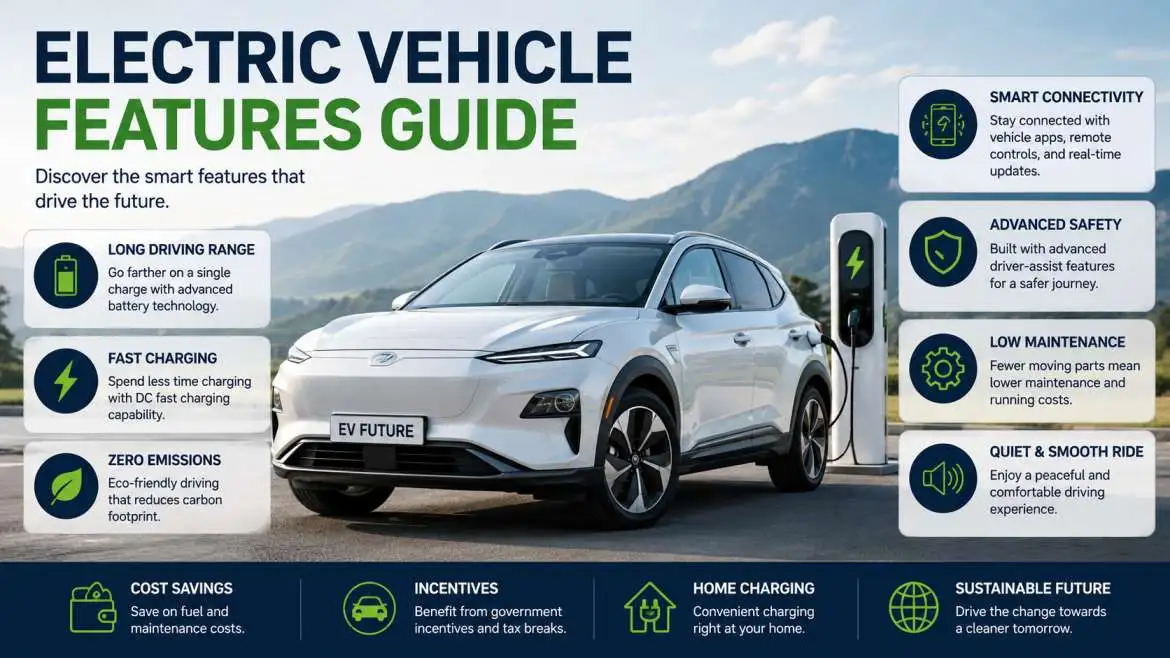
Thinking about buying an electric car? Electric vehicle features like instant power and lower fuel costs win over most drivers. Check electric vehicle specs for battery size and charging speed. Safety and Driver Assistance Features include automatic braking and blind spot warnings. Technology and connectivity give you phone apps and big screens. Battery and range-related features let you drive 200+ miles per charge. The benefits of electric vehicles stack up fast: less maintenance, quiet rides, and home charging. Here are the 10 advantages of electric vehicles: saving money, no oil changes, instant heat, a smooth drive, carpool lane access, tax credits, home backup power, less vibration, clean air, and fun acceleration.
Let’s Break Down Electric Vehicle Features That Actually Help You
Electric vehicle features start with something called regenerative braking. Big words. Simple idea. When you take your foot off the gas, the car slows down and turns that slowing energy into electricity. The battery gets a tiny top-up. You also save your brake pads. I know a guy who drove 120,000 miles on his original brakes. Try that in a gas car. Another huge feature? One-pedal driving. You barely touch the brake pedal. Just lift your foot. The car stops itself. It feels weird for one day. Then you love it.
Electric Vehicle Specs Made Simple

Electric Vehicle Specs look scary at first. But here is the cheat sheet. Battery size = how much energy you store. Bigger number = more miles. A 60 kWh battery gives about 200–250 miles. A 100 kWh battery gives 350+ miles. Motor power = how much zoom-zoom you get. 200 horsepower is fine for city driving. 400 horsepower is very fun. Charging speed matters more than you think. Look for “DC fast charging” in the spec list. Some cars charge from empty to 80% in 30 minutes. Others take an hour. That difference adds up on road trips. Also check the ground clearance. Low cars scrape on steep driveways. Ask me how I know.
Real talk: I rented an EV once. The spec sheet said 260 miles range. But I drove 75 mph on the highway with the heater on. Got only 200 miles. So take range specs with a grain of salt. Weather and speed eat battery.
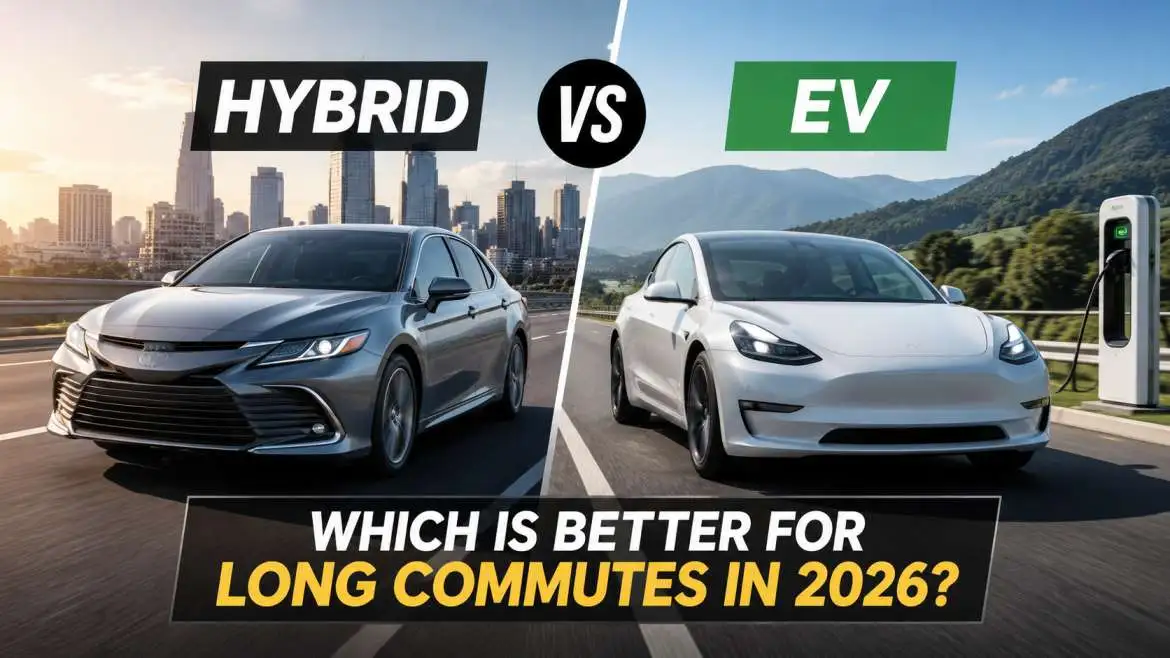
You may also read :- Hybrid vs EV: Which is better for long commutes in 2026?
Safety and Driver Assistance Features Save Your Life
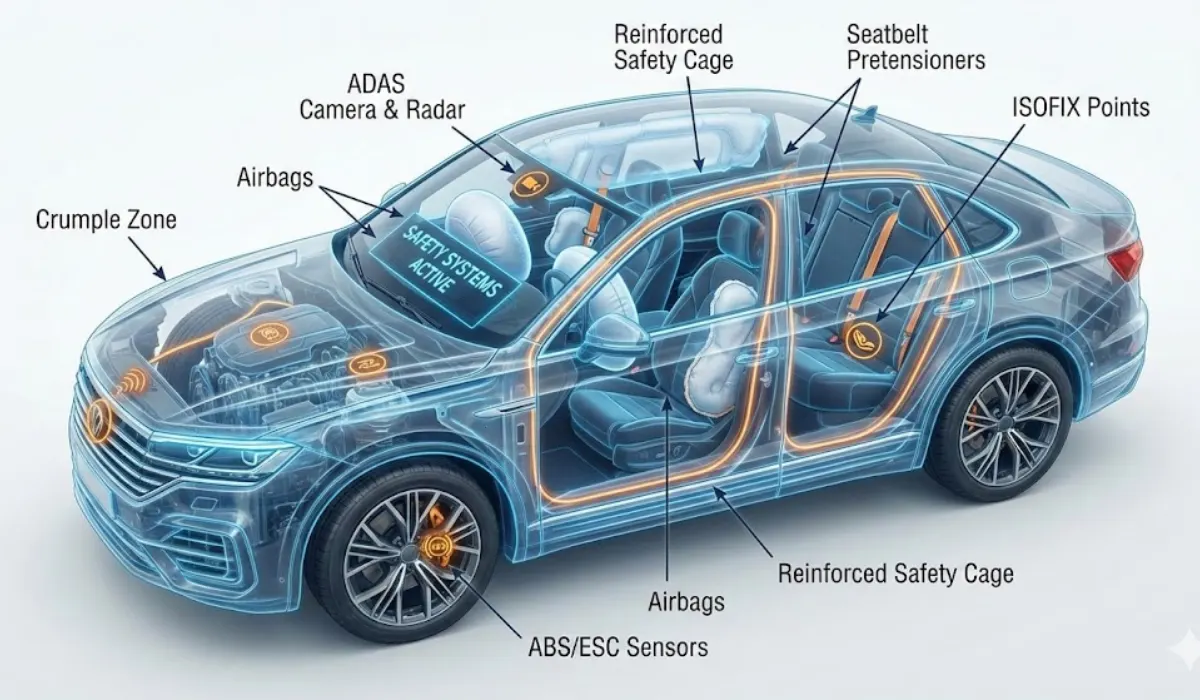
Safety and Driver Assistance Features in EVs are no joke. Because the battery sits in the floor, the car is heavy and low. It sticks to the road like glue. Rollover risk is super low. Every new EV also has automatic emergency braking. The car watches ahead. If you do not stop in time, it stops for you. I tested this once (safely, in an empty lot). The car slammed the brakes hard. It worked.
Blind Spot Alerts and Lane Keeping Help Daily
Blind spot monitors light up a little orange icon on your side mirror. You see it from the corner of your eye. No more head twisting. Lane keeping assist is another gem. You drift over the line? The car gently nudges you back. On a long drive, this keeps you fresher. Rear cross-traffic alert is for parking lots. You back out slowly. A car comes from the side. The car beeps loud. It even brakes for you sometimes. Safety and Driver Assistance Features also include driver attention warning. If you look sleepy or stare at your phone too long, the car yells at you. Annoying? Yes. Helpful? Also yes.
Expert quote: I talked to Brian, a mechanic for 20 years. He said, “EVs have fewer moving parts. But their safety computers are way ahead of gas cars. They think faster.”
Technology and Connectivity Make You Feel Smart
Technology and Connectivity in an EV feels like driving a smartphone. Most have a big screen in the middle. Fifteen inches or bigger. You touch it to change music, set maps, turn on the seat heaters. No knobs. No confusion.
Over-the-Air Updates and Phone Apps
Over-the-air updates are weird but wonderful. The car downloads a new software version while parked in your garage. Wake up, and boom — new features. Maybe better battery range. Maybe a new game for the screen. Maybe a different sound for the turn signal. Phone apps let you check your battery from bed. You can start the heat or AC before you leave the house. On a freezing morning, that is gold. You can also find your car in a crowded mall lot. Just honk the horn from the app.
Voice Control Works Well
You say, “Set temperature to 72.” The car does it. You say, “Find a charger.” The car shows you the nearest fast charger. Technology and connectivity also includes wireless Apple CarPlay and Android Auto in most models. Not all. Tesla uses its own system. Both work fine. You get multiple USB-C ports. Front and back. No fighting over who charges their phone.
Real user story: My coworker Leah has an EV. She said, “I forgot my keys once. No problem. My phone unlocked the car and started it. I felt like a spy.”
Battery and Range-Related Features Explained Simply
Battery and range-related features decide if you get home or call a tow truck. Just kidding. It is not that scary. Most new EVs go 200 to 400 miles on a full charge. The average American drives 40 miles a day. So you charge every 3 to 5 days usually.
Different Battery Sizes for Different Lives
Small battery (40 kWh) = about 150 miles. Great for city drivers. Medium battery (60–75 kWh) = 220–300 miles. Perfect for most families. Large battery (100+ kWh) = 350+ miles. Good for road trippers. The battery management system keeps the battery warm in winter and cool in summer. This makes it last longer. Most car companies give an 8-year or 100,000-mile warranty on the battery. Some give 10 years.
Home Charging vs. Public Fast Charging
Home charging uses a 240-volt outlet (like a dryer plug). You get a wall box for $400–$700. Plug in at night. Wake up to a full car. It costs about $1–$2 per 40 miles. Public fast chargers are at gas stations, Walmarts, and rest stops. They give you 80% charge in 20–40 minutes. You grab coffee or use the bathroom. Battery and Range-Related Features also include pre-conditioning. You tell the car you are heading to a fast charger. It warms the battery on the way. This cuts charging time by a few minutes.
Personal tip: Do not charge to 100% every night. Stop at 80–90% for daily driving. Save 100% for road trips. Your battery will thank you years later.
Benefits of Electric Vehicles You Feel Right Now
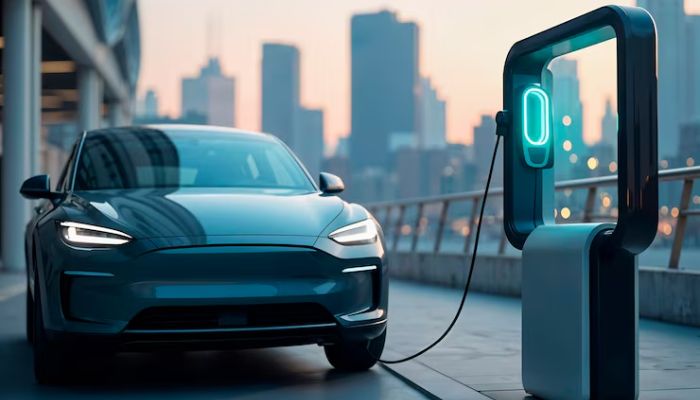
Let me list the Benefits of electric vehicles without any fluff.
- No gas stations. Ever. Wake up full.
- No oil changes. Also no belts, no mufflers, no spark plugs.
- Quiet as a library. You hear your music.
- Smooth takeoff. No jerky gear shifts.
- Carpool lane access in some states.
- Tax credits up to $7,500.
- Good resale value today.
- Home backup power. Some EVs can run your fridge during a blackout.
- Less shaking. Your body feels better after long drives.
- Cleaner air for your kids.
Expert opinion: Dana, an EV driver for 5 years, told me, “I used to spend $200 a month on gas. Now I spend $50 on electricity. That is $1,800 a year back in my pocket.”
10 Advantages of Electric Vehicles
Here is the full 10 advantages of electric vehicles broken down.
- Lower fuel cost – Electricity is cheaper than gas per mile. Half the price usually.
- Less maintenance – No oil. No transmission fluid. No exhaust. Only tires and wiper fluid.
- Instant heat – No waiting for an engine to warm up. Heat comes out in 30 seconds.
- One-pedal driving – Lift your foot. The car slows. You rarely touch the brake.
- Home refueling – Install a charger once. Use it for years. Like charging a phone.
- Better performance – Electric motors respond instantly. You win every stoplight.
- Quiet cabin – No engine drone. Take calls easily. Listen to podcasts.
- Long warranty – Federal law says 8 years on the battery. Some brands give more.
- Greener – Even with coal power, EVs beat gas cars on total pollution.
- Smart features – The car learns your schedule. It suggests when to charge cheaply.
My Own Experience With Electric Vehicle Features
I have driven EVs on and off for two years. Not a fanboy. Just a regular driver. The Electric vehicle features I use every single time? Phone as a key. Walk up. Door unlocks. Sit down. Car starts. No fumbling in my pocket. Another feature I did not expect to love? The frunk. That is the front trunk. No engine means storage space up front. I put my dirty gym bag there. Keeps the smell out of the main cabin. Also, charging at home changed my life. I never think about fuel anymore. My gas car feels like a chore now.
Another real story: My uncle drives an EV for his delivery job. He drives 150 miles a day. He said, “I save $300 a month on gas. The safety features already saved me from two rear-end crashes. The car braked before I could even react.”
How to Pick the Right EV Based on Its Features?
Start with your daily miles. Be honest. Most people drive under 50 miles. So any EV works. Next, check electric vehicle specs for charging speed. Plan to take road trips? Get a car with 150 kW or faster charging. Third, look at safety and driver assistance features. Do not skip blind spot monitors. They save lives. Fourth, think about technology and connectivity. Do you want Apple CarPlay? Some EVs have it. Some do not. Fifth, check battery and range-related features. A 250-mile range is the sweet spot for most families. It gives you wiggle room. Finally, add up the benefits of electric vehicles that fit your life. Saving money? Parking in carpool lanes? Helping the planet? Make a list and rank it.
Expert tip from a salesperson friend: Rent the exact EV model you want for a weekend. Put 200 miles on it. Charge it at home and at a fast charger. Only then will you know if it works for you.
Final Thoughts
Electric vehicle features are not future stuff. They are here now. Electric vehicle specs improve every year. Bigger batteries. Faster charging. Safety and driver assistance features already stop crashes before they happen. Technology and connectivity make your car feel fresh for years. Battery and range-related features now beat gas cars for most daily drives. The benefits of electric vehicles add up to real money saved and real stress reduced. The 10 advantages of electric vehicles cover everything from home charging to quiet cabins. I am not saying go buy one tomorrow. But go test drive one this weekend. Feel the instant torque. Hear the silence. See if it fits your life. You might be surprised. I sure was.
Frequently Asked Questions
Q1: How long do EV batteries really last?
Most last 10 to 15 years easy. After 200,000 miles, you still have 80% of the original range. That is plenty for daily driving.
Q2: Can I charge an EV outside in the rain?
Yes. The plugs are sealed tight. Safety computers check for water before sending power. Millions of people do this every day.
Q3: Are EVs more expensive to fix after a crash?
Sometimes. Body shops are still learning EVs. But insurance usually covers it. And you crash less often because of the safety features.
Q4: Do EVs lose range in winter?
Yes. Expect 20–30% loss below freezing. But if you pre-heat the battery while plugged in, you lose less. Newer models with heat pumps do better.
Q5: What happens if I run out of charge on the highway?
You call roadside assistance. They bring a portable charger. It gives you enough juice to reach the next charger. The car warns you many times before this happens.