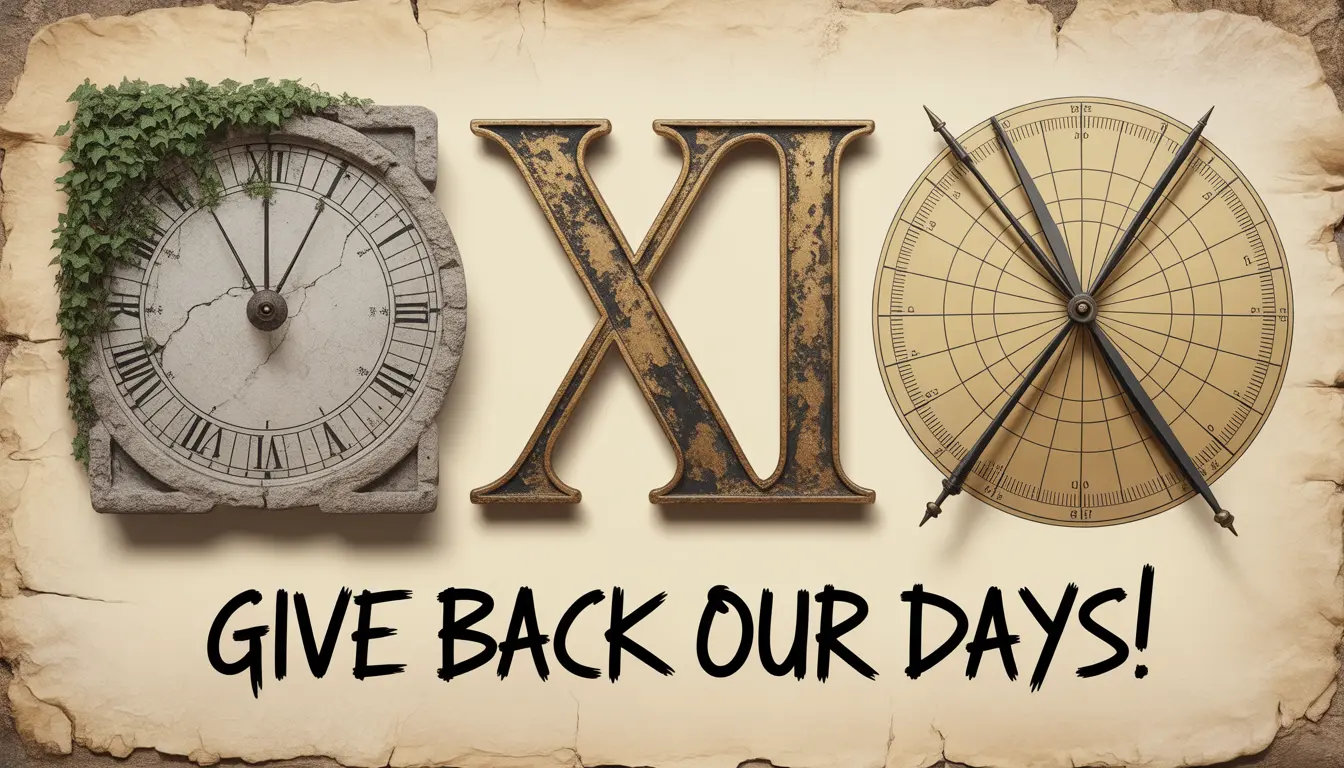
The clash between the Julian vs. Gregorian New Year is a forgotten drama that once set the streets of Britain alight with protest. It’s a tale not just of calendars and dates, but of stolen time, public rebellion, and a stubborn nation dragged into sync with the heavens. Our modern celebration on January 1st is the peaceful endpoint of a centuries-long war over how we mark time. This is the true, chaotic story of 1752, the year the British government deleted 11 days from history and sparked a legendary outcry that still echoes in the phrase, “Give us back our eleven days!”
Part 1: The Great Calendar Divide – A Flaw in Time
To understand the riot, we must first understand the war between two systems of time. The core of the Julian vs. Gregorian New Year conflict lies in a simple astronomical miscalculation that grew into a colossal problem.
The Julian Calendar: Rome’s Grand, Imperfect Gift
Instituted by Julius Caesar in 46 BC, the Julian calendar was a marvel of ancient bureaucracy. It established a 365-day year with a leap day every four years, based on a solar year calculated as 365.25 days. For over 1,600 years, it ordered the lives of Europe. But its fatal flaw was that tiny decimal. The true solar year is approximately 365.2422 days long. That 11-minute annual discrepancy meant the calendar drifted slowly from the seasons. By the 16th century, the spring equinox—used to calculate Easter—had wandered ten days off course. The Julian New Year, which had long settled around March 25th in Britain, was increasingly out of step with the natural world.
The Gregorian Calendar: A Pope’s Precision Fix
In 1582, Pope Gregory XIII took radical action. The Gregorian calendar introduced a new leap year rule: century years (like 1700) would only be leap years if divisible by 400. This corrected the drift almost perfectly. To realign the calendar immediately, he ordered ten days erased. That October, people went to bed on the 4th and woke up on the 15th. Catholic nations like Spain, Portugal, and France complied swiftly. The Gregorian New Year of January 1st was reaffirmed. But beyond the Catholic sphere, the decree met fierce resistance, setting the stage for a historical showdown.
Infographic showing the accumulating drift of the Julian calendar over centuries, with alt text: "Visual timeline illustrating the growing error that forced the Julian vs Gregorian New Year reform."
Part 2: Protestant Stubbornness – Why Britain Waited 170 Years
While Europe modernized, Britain clung to the old Julian calendar with a vice-like grip. This 170-year delay is key to the drama of 1752 and was fueled by more than just tradition.
- The "Popish Plot" Fear: In the fiercely anti-Catholic climate of post-Reformation England, the Gregorian calendar was seen as a "Papist" imposition. Adopting it was politically toxic, viewed as bowing to Roman authority. Prominent clergymen and scholars argued against it on principle, even as the scientific evidence mounted.
- The Chaos of Change: The practical obstacles were daunting. Changing the calendar would disrupt everything: legal contracts, lease agreements, tax collection, market fairs, and salary payments. The entire administrative and financial machinery of the nation was built on the old timeline. The cost and confusion seemed insurmountable.
- A Matter of National Pride: To many, the old calendar was simply theirs. This national stubbornness is a fascinating thread in the Julian vs. Gregorian New Year saga. Scotland, however, broke ranks early, adopting January 1st as its New Year in 1600, creating a bizarre situation where the island shared a kingdom but not a calendar.
The tipping point came from an unlikely alliance: scientists and merchants. Astronomers were frustrated by the inaccuracy. Merchants and diplomats were increasingly hampered by the 11-day discrepancy in correspondence and treaties with Europe. The pressure for change finally overcame deep-seated prejudice.
Part 3: 1752 – The Year Time Jumped
The British Calendar (New Style) Act of 1750 mandated the inevitable. Britain would finally fall in line. The correction was brutally simple: to sync with the solar year, 11 days would vanish.
The Great Adjustment: Britons went to sleep on Wednesday, September 2, 1752, and woke up on Thursday, September 14, 1752. The dates of September 3 through 13 were legally expunged. Overnight, autumn was 11 days closer.
But the Act did something just as significant: it moved the official start of the British year. From 1752 onward, the New Year would begin on January 1, not March 25. This finally ended the confusing practice of "double-dating," where dates between January and March were written with two years (e.g., February 1746/47).
The "Calendar Riots" – Myth Versus Reality
This is where legend takes hold. The famous cry, "Give us back our eleven days!" has become shorthand for a violent public uprising. The truth is more nuanced but no less compelling.
Modern historians suggest widespread, organized violence was unlikely. Instead, there was a profound and angry public confusion fueled by very real grievances:
- The Landlord's "Windfall": Many landlords demanded a full month's rent for the shortened 19-day September. Tenants rightly felt robbed, believing they were paying for time that no longer existed.
- Wage Fears: Labourers worried they would be paid for 11 fewer days of work, cutting their autumn income.
- Superstitious Dread: A deep-seated belief that the government was literally shortening lives or interfering with divine order took hold. Pamphlets and sermons asked if people would lose 11 days of their life or if their birthdays were now invalid.
The phrase "Give us back our eleven days!" was brilliantly immortalized not on a protest banner, but in an election engraving by William Hogarth in 1754. It showed a rowdy crowd with this slogan, lampooning the ignorance of voters. Hogarth’s art cemented the event in the national memory as a riot, proving that sometimes perception shapes history more powerfully than fact.
An image of Hogarth's 1754 election engraving, with alt text: "William Hogarth's satirical art mocking public reaction to the Julian vs Gregorian New Year change."
Part 4: The Lasting Legacy – Shadows of the Old Calendar
The switch left a permanent mark on British history, culture, and how we understand the past. The Julian vs. Gregorian New Year conflict isn't just a closed chapter; its effects are still felt today.
For Historians & Genealogists: This is the "Old Style / New Style" dilemma. Any document from the British Isles before 1752 requires careful dating. A recorded event like "the Battle of Marston Moor, July 2, 1644" is in Julian (Old Style). To convert it to our modern Gregorian equivalent, you must add 10 days, making it July 12, 1644. For family historians, an ancestor’s birthdate recorded in early 1750s parish registers can be a puzzle wrapped in a calendar.
In Modern Traditions: The old calendar survives in beautiful, anachronistic ways.
- Orthodox Christmas: Many Eastern Orthodox churches still use the Julian calendar for liturgical celebrations. Their December 25th falls on our January 7th. This direct link to the pre-1752 calendar is a living relic of the Julian New Year system.
- Old Christmas Day: In some remote parts of the UK, like parts of Wales and the Scottish Highlands, "Old Christmas Day" was celebrated on January 6th well into the 19th century, a folk memory of the lost time.
A Perfect Calendar? Not quite. The Gregorian system still has a tiny error (about one day every 3,030 years). Furthermore, the debate over the most "correct" calendar is alive in academia and astronomy.
People Also Ask: Unpacking the Calendar Controversy
Q: What did people think happened to the "lost" 11 days?
A: Rumours ran wild. Some believed their lifespan was shortened. Others thought the missing days would be added to the end of time during the Biblical apocalypse. Many saw it as pure financial theft by the elite.
Q: Is the Julian calendar still used anywhere?
A: No nation uses it as a civil calendar. However, as noted, it remains crucial for the liturgical year in several Orthodox Christian traditions. Astronomers also use a related "Julian Day" system for scientific calculations.
Q: How do I convert an Old Style date to a New Style date?
A: For English/British events between 1582 and 1752, add 10 days. For events before 1582, the conversion varies. Reputable academic sources, like the archives at The National Archives UK, provide detailed guidance for researchers.
Q: Were other countries affected similarly?
A: Yes! Protestant regions reacted with similar suspicion. The American colonies (under British rule) adopted the change in 1752, with Benjamin Franklin famously quipping about the extra sleep gained. Sweden’s attempt to transition gradually by skipping leap years was so botched it created an entirely unique calendar for 40 years.
Conclusion: From Riots to Revelry
The journey from the Julian to the Gregorian New Year is a powerful parable of progress. It shows how science, religion, politics, and public sentiment collide. Britain’s late, chaotic adoption was a final, stubborn stand against a changing world.
When the clock strikes midnight this December 31st, remember that you're celebrating more than a new beginning. You're marking the hard-won victory of accuracy over error, of global alignment over isolated tradition. That peaceful countdown is the direct descendant of a national uproar—a reminder that the way we measure our days is a human story, written in dates, decrees, and the defiant cry of a people who refused to let their time be taken without a fight. The echo of 1752 reminds us that our calendar is not just a chart of days, but a chronicle of our constant struggle to harmonize human life with the immutable turning of the heavens.