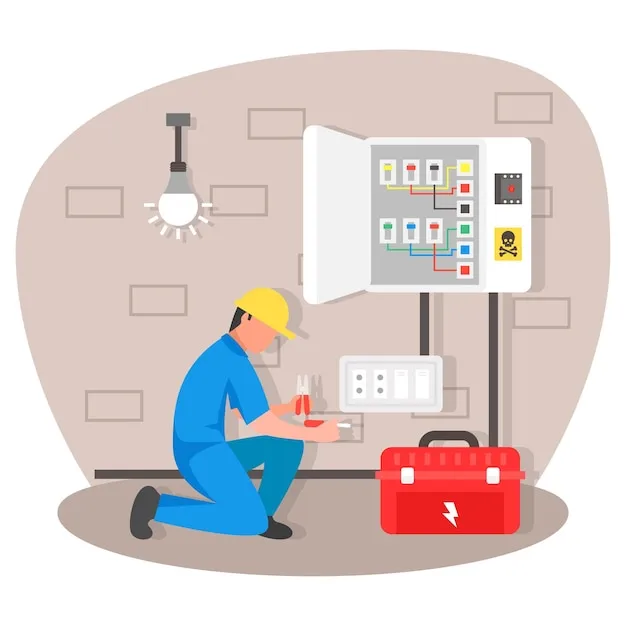
Every home has a silent guardian. It works behind the walls, inside a metal box. This is your electrical service panel. You might call it the fuse box or breaker panel. It's the command center for all the electricity in your house.
Its most important job is safety. The devices inside, called circuit breakers, are designed to "trip" or shut off. They do this when a circuit is overloaded or there's a dangerous short. This action prevents wires from overheating, which can cause fires.
Knowing how this system works is the first step to DIY electrical troubleshooting. It empowers you to handle minor issues safely and know when to call a professional.
Repair Circuit Breaker Secrets for Easy DIY Mastery
Let's clear something up right away. The phrase "repair circuit breaker" is a bit of a misnomer. Most of the time, you are not actually repairing the breaker itself. You are resetting a tripped breaker or replacing a faulty one. The real "secrets" are in the diagnosis and the safe process.
Mastering a few simple electrical repairs starts with understanding why a breaker trips. Think of a circuit like a road. Electricity are the cars. An overload is like a traffic jam—too many cars (appliances) on one road (circuit). A short circuit is like a car crashing off the road—electricity takes a dangerous, unintended path.
The secret to home electrical work is always, always safety first. What follows is a friendly, step-by-step guide to handling a tripped breaker like a pro.
Also read :- Transform Living Spaces with This Futuristic Smart Home Opportunity
Secret #1: The Safe and Simple Reset Process
Most trips are solved by a proper reset. It's not just flipping a switch! Here’s the correct way to reset a breaker:
- Turn Off & Unplug: Go to the room with no power. Unplug all devices or turn off lights on that circuit. This removes the load and helps prevent an immediate re-trip.
- Find Your Panel: Locate your main electrical panel. It's often in a basement, garage, or utility closet.
- Identify the Tripped Breaker: Look for the breaker handle that is not fully in the "ON" position. It may be in a middle "OFF" position or slightly flipped. It will feel different from the others.
- The Reset Motion: Firmly push the handle all the way to the "OFF" position. You should hear and feel a click. Then, push it firmly to the "ON" position. Another click.
- Test: Go back and test the circuit. Plug in a simple lamp first before turning on high-power devices.
This basic breaker fix solves about 90% of "no power" issues. If it trips again immediately, you have a deeper issue.
Secret #2: Smart Diagnosis Before Any Action
Why did it trip? Jumping to reset without asking "why" is a common mistake. Ask yourself:
- What was running? Did you just start the vacuum, space heater, or hair dryer? This points to an overloaded circuit.
- Any recent changes? Did you just install a new appliance or light fixture? This could indicate a wiring issue.
- Any strange signs? Did you hear a pop, see a spark, or smell something burning? If you smell burning, do not touch the panel. Call an electrician immediately.
This troubleshooting home circuits step is what separates a mindful DIYer from someone just flipping switches.
Secret #3: Mapping Your Breaker Panel Like a Pro
A huge DIY electrical troubleshooting secret is knowing which breaker controls what. An unlabeled panel is frustrating and unsafe.
Grab a helper and a radio. Have your helper plug in a radio (turned up) in a room. Go to the panel and flip one breaker off. If the radio stops, you've found that circuit! Label it clearly on your panel directory. This home electrical safety task is one of the most valuable things you can do.
When Replacement is the Real Solution: A Step-by-Step Guide?
If a breaker refuses to stay reset (and you've unplugged everything), it might be faulty. Here’s how to safely replace a circuit breaker.
CRITICAL WARNING: Working inside an electrical panel carries a high risk of severe shock or electrocution. If you are uncomfortable at any point, STOP and call a licensed electrician. This is for informational purposes only.
What You’ll Need:
- A new breaker of the EXACT same type, brand, and amperage (e.g., 15-amp GE single-pole).
- A non-contact voltage tester.
- A flashlight.
- Insulated screwdrivers.
The Process:
- Shut Off the Main Breaker: This cuts all power to the panel except the large wires coming from the utility. The area around these lugs is ALWAYS LIVE. Do not touch them.
- Verify Power is Off: Use your non-contact voltage tester. Carefully test around the breaker you're removing and the wires connected to it. Test it on a known live circuit first to ensure it works.
- Remove the Panel Cover: Unscrew the faceplate. Set it aside.
- Disconnect the Wire: The circuit wire is held under a screw on the breaker. Loosen this screw and gently pull the wire out.
- Remove the Old Breaker: Breakers clip onto a central bar. Gently but firmly pry the outer edge of the breaker away from the center. It will unclip and pull out.
- Install the New Breaker: Clip the new breaker onto the bar, matching the position of the old one. It should snap firmly into place.
- Reconnect the Wire: Insert the wire under the terminal screw on the new breaker and tighten it securely. Ensure no bare wire is exposed.
- Reassemble and Restore Power: Put the panel cover back on. Turn the Main Breaker back on. Then, turn on your new breaker.
As master electrician James Rivera notes, "The most common error DIYers make is using the wrong breaker type. Not all brands are compatible, even if they look the same. Using the correct manufacturer is non-negotiable for safety."
Advanced Secrets and When to Stop
- The "Double 20" Secret: Many homes have "double-pole" breakers (two handles tied together). These control 240-volt appliances like dryers or stoves. The reset process for double pole breakers is the same, but you must flip both handles fully off, then on.
- GFCI & AFCI Breakers: These have "test" buttons. If one trips, you must push the handle OFF before resetting it to ON. Pushing the "reset" button alone often won't work.
- The Ultimate Secret: Knowing when to call for help. If you see scorch marks, smell burning, hear buzzing, or if problems keep happening, it's time. This isn't failure; it's smart home electrical safety.
Empowerment Through Knowledge and Caution
Learning these repair circuit breaker secrets for easy DIY mastery gives you confidence and safety. You can solve simple outages quickly. More importantly, you understand your home's electrical system. This helps you describe problems accurately to an electrician, saving time and money.
Remember, the goal isn't to become a licensed electrician overnight. The goal is to be a capable, safe homeowner who knows the limits of do-it-yourself electrical fixes. Respect the power, follow the steps, and never hesitate to call in the experts for the big jobs. Your home's safety—and your own—depends on it.
Frequently Asked Questions
Q: Is it safe for me to do this myself?
A: Resetting a clearly tripped breaker is generally safe if you follow the steps. Replacing a breaker or any work inside the panel should only be done by those with knowledge and extreme caution. When in doubt, hire a pro.
Q: How much does an electrician charge to replace a breaker?
A: Typically between $150 and $250, depending on your location and the job's complexity. It's often a relatively quick job for them.
Q: Can a tripped breaker cause other problems?
A: Usually, no. It's an isolated safety event. However, constantly resetting a breaker without fixing the root cause can damage appliances and wiring over time.
Q: Why does my breaker trip when it rains?
A: This often points to moisture getting into an outdoor outlet, fixture, or junction box. This is a serious issue that requires an electrician to find and seal the leak.
Q: What's the difference between a short circuit and an overload?
A: An overload is too much demand on one circuit (too many appliances). A short circuit is when a "hot" wire touches a "neutral" or "ground" wire directly, causing a huge, instant surge. A short often causes a loud "pop."