So you want to know about the solar system. Okay. Fine. But let me warn you. This is not going to be like those boring textbooks you had in school. You know the ones. Big words. Lots of numbers. Nothing that sticks in your head. I hated those books. Still do.
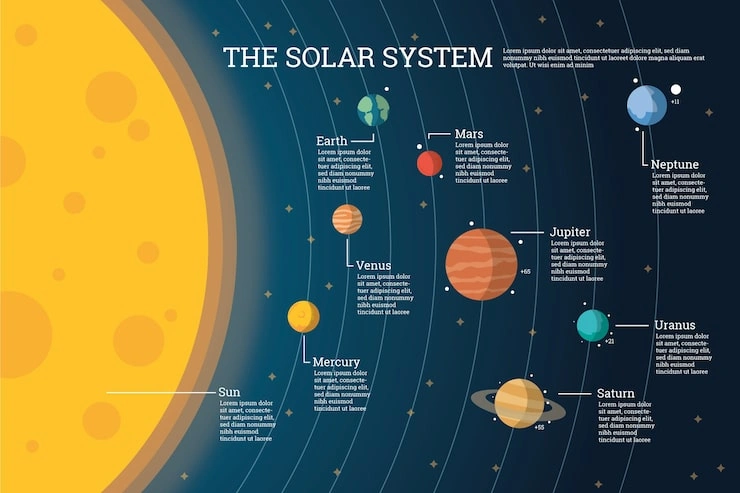
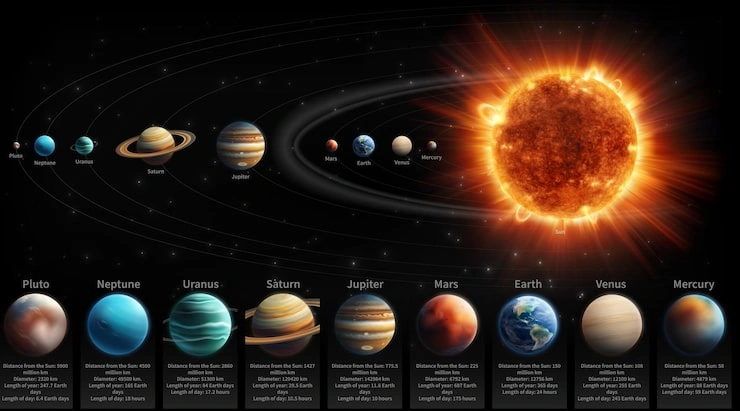
The solar system is wild. And I mean truly wild. You think you know it. You learned about the planets in third grade. Mercury. Venus. Earth. Mars. Jupiter. Saturn. Uranus. Neptune. Maybe Pluto if you are old enough to remember when it counted. But that is just the surface. That is like saying you know a person because you know their name. There is so much facts about the solar system for adults.
Where Did All This Come From?
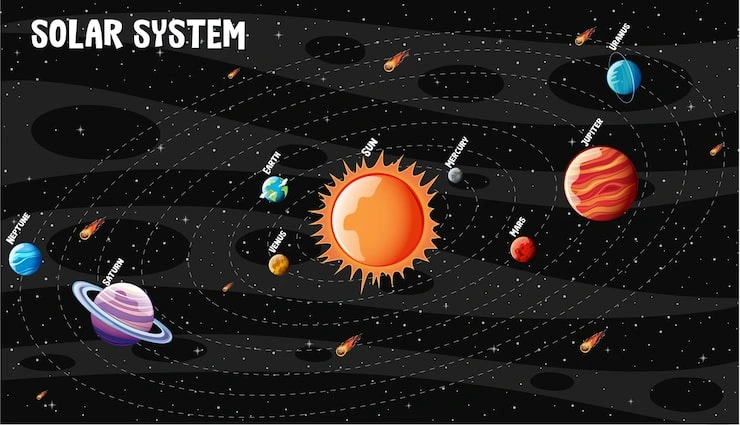
This whole thing started 4.6 billion years ago. That is a number people throw around but nobody really gets. Like what does 4.6 billion even mean. It means everything we see. Everything we touch. Everything we are. It all came from one giant cloud of gas and dust. Imagine a cloud so big it fills the entire sky. That cloud started spinning. And spinning. And spinning faster. The center got so hot. So packed. It lit up. That was the sun.
The leftover stuff. The bits that did not fall into the sun. Those clumped together. Slowly. Over millions of years. And that became the planets. It took forever. But forever is what you have when you are the universe. Time does not matter the same way.
Read Also: Geography Facts For Students In India
The Sun Is Kind of a Big Deal
The sun is everything. Really. It is 99.9 percent of all the mass in the solar system. That leaves 0.1 percent for everything else. Everything. That is insane when you think about it. Jupiter is huge. You know that. You can fit 1,300 Earths inside Jupiter. But Jupiter is nothing compared to the sun. The sun could swallow 1,000 Jupiters. Easy.
But the sun is not just sitting there being a giant ball of fire. It is active. It has these explosions. Solar flares. They send out radiation and particles. Sometimes they hit Earth. And when they do. It is not good. Satellites go down. Power grids get messed up. Astronauts have to hide behind shields. The sun is beautiful. But it is also dangerous.
Here is something crazy. The sun's outer layer. The corona. It is way hotter than the surface. That makes no sense. At all. You touch a stove. The stove is hot. You move your hand away. The air is cooler. That is how heat works. Except on the sun. On the sun, the air around it is hotter than the thing itself. Scientists have been scratching their heads about this for years. They still do not know why.
Mercury Is Not What You Think
Mercury is the closest to the sun. You would expect it to be the hottest. But no. That is Venus. Mercury has almost no atmosphere. So the heat just bounces off. During the day, it is scorching. 430 degrees Celsius. At night. Boom. -180 degrees. That swing is brutal. Nothing survives that.
I remember reading somewhere that Mercury has ice. Ice! Near the sun. At the poles. In craters that never see sunlight. Permanent shadows. So the ice stays frozen. Forever. That blew my mind. The closest planet to the sun has ice. And the hottest planet is not even the closest. Space is weird.
Venus Is a Nightmare
Venus is Earth's twin. Same size. Same mass. But that is where the similarities end. Venus is hell. Pure hell. The temperature is around 460 degrees Celsius. All the time. Day and night. No relief. The atmosphere is thick with carbon dioxide. That traps heat. Greenhouse effect on steroids. The pressure is unbearable. Imagine being 900 meters underwater. That is what it feels like on Venus.
And the clouds. Sulfuric acid clouds. Not water. Not anything friendly. Acid. It rains acid on Venus. Not that it gets that far. The acid evaporates before hitting the ground. But still. Acid rain. Venus is not a place you want to visit.
It spins backwards too. Most planets spin one way. Venus spins the other. Nobody knows why. Maybe something hit it. Maybe it just happened that way. Either way. It is strange. And I love strange.
Earth Is Home. But We Take It for Granted.
Earth. Our home. We have water. Liquid water. Oceans of it. We have air. Breathable air. We have a magnetic field that protects us from the sun's radiation. Without that field, we would be dead. Simple as that. The solar wind would strip our atmosphere away. Just like Mars.
Mars had water once. And a magnetic field. And an atmosphere. But something happened. The magnetic field died. And everything fell apart. That could happen to us. Not tomorrow. Not next year. But eventually. It is a reminder that we are fragile. We depend on so many things working together.
Mars and Its Secrets
Mars is the dream. People want to go there. They want to live there. But Mars is cold. -60 degrees Celsius on average. The air is thin. You cannot breathe. The dust is everywhere. It gets into everything. And it is toxic. The soil has chemicals that would hurt you. It is not a nice place.
But it was nice once. Scientists have proof. Water flowed on Mars. Rivers carved canyons. Lakes sat in craters. There might have been an ocean. A huge one. That water is gone now. Some of it is frozen at the poles. The rest escaped into space when the atmosphere disappeared.
What killed Mars? The magnetic field. It just stopped. We do not know why. That is the big question. Why did Mars lose its magnetic field. If we can figure that out. We might understand more about our own planet. And maybe we can avoid the same fate.
Jupiter Is Too Big
Jupiter is massive. 1,300 Earths fit inside. That number is hard to picture. Just imagine. 1,300 of our planets. All squished into one. That is Jupiter. It is mostly hydrogen and helium. Gases. No solid surface. Just gas getting thicker and thicker until it turns into liquid. And maybe a core down there. Maybe not.
Jupiter spins fast. One day is under 10 hours. That is fast. The planet is spinning so hard that it bulges at the equator. The winds are fierce. Storms rage. One storm has been going for hundreds of years. The Great Red Spot. It is bigger than Earth. A storm bigger than our whole planet. And it never stops. Never.
Jupiter protects us. Its gravity pulls in asteroids and comets. They hit Jupiter instead of us. That happened in 1994. A comet crashed into Jupiter. Everyone watched. It was huge. If that comet had hit Earth. We would not be here. Jupiter took the hit for us.
Saturn and Its Pretty Rings
Saturn is the pretty one. Everyone loves the rings. They are gorgeous. But they are just ice. Tiny bits of ice. Billions of them. Some as small as dust. Some as big as houses. They orbit Saturn in a flat disc. They look solid from a distance. But they are not. They are thin. A kilometer thick. That is nothing.
The rings came from somewhere. Probably a moon. An icy moon. It got too close to Saturn. The gravity pulled it apart. Now those pieces orbit Saturn forever. Beautiful. But born from destruction.
Saturn is light. Less dense than water. If you put Saturn in a giant pool, it would float. That is funny to think about. The second largest planet. Floating like a beach ball. Saturn also has moons. Titan is the biggest. Titan has an atmosphere. Thick and hazy. It has lakes. But not water lakes. Methane lakes. Liquid methane. And it rains methane. The temperature is -180 degrees Celsius. Nothing like Earth. But Titan could have life. Different life. Life that breathes methane instead of facts about the solar system for adults.
Uranus and Neptune Are the Odd Ones
Uranus is sideways. Completely tilted. Nearly 90 degrees. Something hit it. Hard. A long time ago. Now it rolls around the sun like a ball. Weird. It is an ice giant. That means it has more water and methane than Jupiter and Saturn. The methane gives it a blue color.
Neptune is the farthest. It takes 165 years to orbit the sun. That is a long time. Longer than any human life. Neptune has the strongest winds. 2,100 kilometers per hour. Faster than anything on Earth. Why? Nobody knows. It is cold and dark and windy. Not a great vacation spot.
Moons Are Underrated
Everyone talks about planets. But moons. Moons are where the action is.
Io. Jupiter's moon. Volcanoes everywhere. Hundreds of them. Erupting all the time. The surface is yellow and red. Sulfur. It looks like a pizza. I am not joking. A pizza. The gravity from Jupiter and other moons squeezes Io. Friction heats it up. That causes the volcanoes. It is the most active place in the solar system. And it is a moon.
Europa. Another Jupiter moon. Ice on the surface. Ocean underneath. Liquid water. More water than all of Earth's oceans combined. And where there is water. There might be life. Scientists are dying to explore Europa. They want to drill through the ice. They want to see what is swimming down there. Maybe nothing. Maybe something. We will not know until we look.
Ganymede. Biggest moon. Bigger than Mercury. Has its own magnetic field. That is rare. Callisto. Covered in craters. Oldest surface in the solar system. Billions of years of impacts. Nothing has changed.
Enceladus. Saturn's little moon. Has geysers. Water geysers. Shooting out from the south pole. That water comes from an ocean. Another ocean. Another place where life could be. It is everywhere. Water is everywhere. And where there is water. There is hope.
You May Also Like: How Long Is The AP Government And Politics Exam
The Asteroid Belt. The Kuiper Belt. The Oort Cloud.
Between Mars and Jupiter. The asteroid belt. Rocks. Tiny rocks. Big rocks. Ceres is the biggest. It is a dwarf planet. Almost 1,000 kilometers across. Not huge. But not tiny either. The asteroids are leftovers. Stuff that never became a planet. They just hang out there. Bumping into each other.
Beyond Neptune. The Kuiper Belt. Icy bodies. Pluto lives there. Pluto. Poor Pluto. Was a planet. Now it is not. The definition changed. Pluto did not meet the new rules. It is still there. Still interesting. Still has mountains made of ice. Still has an atmosphere. Still has moons. It is not any less special because we call it a dwarf planet.
Further out. The Oort Cloud. A giant sphere of ice chunks. Comets come from there. Long period comets. They take thousands of years to orbit the sun. It is so far away. Light takes over a year to reach the Oort Cloud. Voyager 1 is out there. Been traveling since 1977. It will reach the Oort Cloud in 300 years. 300 years from now. That is how big our solar system is. We are tiny. Everything is huge.
Big Questions Nobody Can Answer
Is there a Planet Nine? Some people think so. There are patterns in the orbits of distant objects. Something is pulling on them. Something big. Maybe 10 times bigger than Earth. But we have not seen it. It is too far. Too dark. Too cold. It could be out there. Hiding. Waiting. Why did Mars lose its magnetic field? That is a big one. The magnetic field protected Mars. Then it disappeared. The atmosphere went away. The water went away. Mars became what it is today. What happened? We do not know. We might never know. But we keep looking. Is there life out there? Anywhere. Anywhere at all. Europa. Enceladus. Maybe Titan. Maybe somewhere we have not even thought of. It does not have to be like us. It could be completely different. We have no idea. And that is exciting. That is the best part. We do not know.
So What Does All This Mean
It means we are small. Very small. Our problems. Our worries. They are small too. That is not a bad thing. It is freeing. We are part of something much bigger. We are part of this solar system. A tiny speck in a tiny corner of the universe. But we are here. We are alive. We get to look up and wonder. We get to ask questions. We get to send robots to other planets. We get to discover things. That is amazing. The solar system is not just a collection of rocks and gas. It is our home. And it is beautiful. And strange. And full of surprises. Look up tonight. Find a planet. Any planet. Venus is bright. Jupiter is brighter. You can see them with your own eyes. Think about what they are. Where they are. How far away. How different. And know that you are part of this. You are part of the solar system. And that is pretty cool.